FREE MATERIALS
Safe Childhood
and Adolescence
Free materials for caregivers — to understand and support children and adolescents, both typical and neurodivergent.
Free materials for caregivers — to understand and support children and adolescents, both typical and neurodivergent.
You do not need to be certain in order to ask for help. It is not the family's job to investigate, gather proof or work out what happened. It is the family's job to protect and to seek support — and how the adults respond in the first days carries enormous weight in what follows.
These materials were written for that moment. They are free, can be printed and shared, and include humanised listening from the perspective of the Greenspan Floortime Approach®: before asking a child what happened, you have to know whether she can, at that moment, answer.
“Don't talk to strangers” is one of the least protective things we say. In most cases of violence against children, the person responsible is someone the child knows. These three booklets do not teach fear — they teach a child to recognise situations, to listen to her own body and to tell.
A story with Tuca the armadillo, to read together with an adult.
Learn to read the signals — on the street, at school, at home and in the game.
Self-protection, crowded places, wandering and crisis management.
No legislation from any particular country — with a page to write down your local services.
For families of children who have experienced violence.
For families in a difficult separation or custody dispute. It takes no sides.
Recognising indications of violence in neurodivergent children.
Sexuality and neurodivergence, from childhood to adolescence.
Bullying, cyberbullying and inclusion of neurodivergent children and adolescents.
Emotional distress in children and adolescents — how to notice, how to ask and what to do.
The other booklets are for the people who care for them. This one was written for the adolescent to read alone — and can be sent directly.
About not being okay, not finding the words, and managing to ask for help anyway.
These materials offer guidance on care and communication. They are not legal advice and do not describe the laws or services of any particular country. Procedures for reporting and for hearing a child differ between countries — always check what applies where you are.
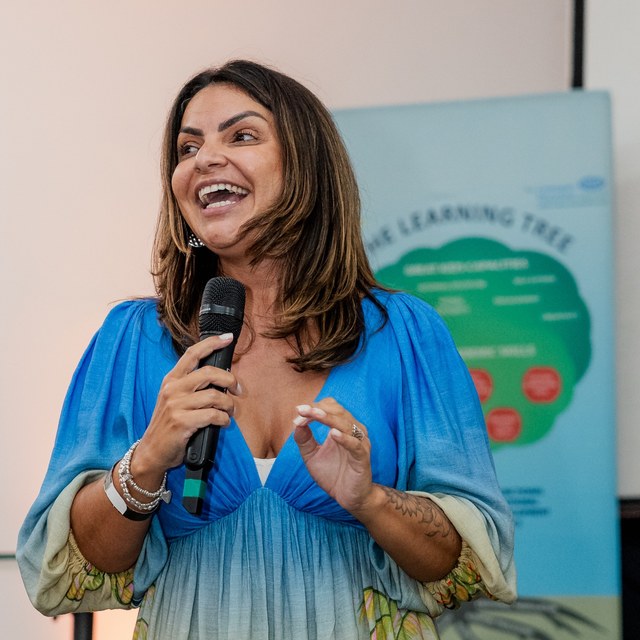
I am a speech-language pathologist and the Official Representative of the Greenspan Floortime Approach® in Brazil. I have worked for years with child development, autism and family coaching.
Along the way one thing became clear: a child who cannot communicate cannot ask for help. Functional communication is not only a therapeutic goal — it is a protective measure.
That is where Na Rota do Afeto came from, the social arm of Instituto Greenspan Floortime Brasil. With it I have taken training and protection materials to Nigeria, Marajó and the Upper Amazon. In all of them, the same gap: protection materials never arrive — or arrive in a language nobody there speaks.
That is why everything here is free, in three languages, and made to circulate.
Founder of Instituto Greenspan Floortime Brasil and of Interagindo — Espaço do Desenvolvimento, in Rio de Janeiro.